Implemented
Python reference node
Validate a linear account-state chain, exchange P2P v2 messages, persist blocks in RocksDB, and keep pending transactions in Redis.
Node setup →Luracoin is an educational proof-of-work network with a readable Python node, a local-first wallet, and an explorer designed to expose blocks and account state clearly.
No mainnet. No real-value assets. No independent security audit.
Learn the whole system
Luracoin keeps the stack compact enough to follow end to end, while implementing real cryptography, networking, persistence, and account-state rules.
Validate a linear account-state chain, exchange P2P v2 messages, persist blocks in RocksDB, and keep pending transactions in Redis.
Node setup →Create or restore a 24-word wallet, keep its encrypted vault on your machine, sign locally, and talk only to your loopback node.
Meet the wallet →Search blocks, transactions, and addresses through a transparent interface. The live read-only API is currently being completed.
Explore the preview →Start from source
The reference implementation is intentionally approachable. Set up Python and Redis, start a testnet node, then inspect its status from the same machine. The public alpha source release is still being prepared.
Use an isolated Python environment and install the development extras.
Redis holds the mempool; the blockchain itself remains in local files and RocksDB.
Start isolated or add only peer addresses you control. Public seeds are not available yet.
# From the current alpha source checkout
cd luracoin-python
# These examples use supported Python 3.12
python3.12 --version
python3.12 -m venv .venv
source .venv/bin/activate
python -m pip install -e ".[dev]"
Then start a local nodeluracoin node --network testnet --host 127.0.0.1 --port 9999 --rpc-port 18444
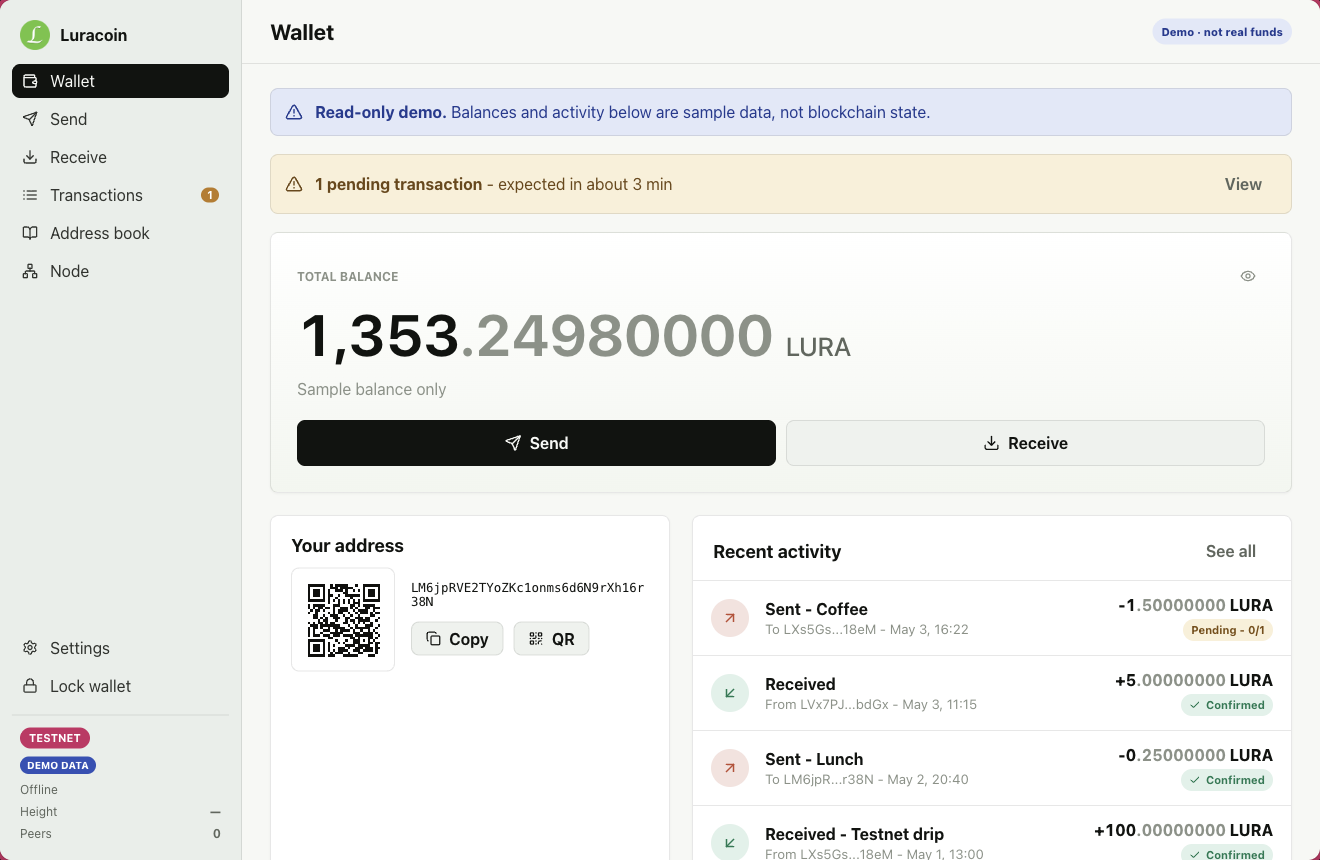
Your keys stay local
The renderer never receives the node's RPC bearer token. Electron reads it in the main process; browser mode uses a tightly scoped same-origin gateway served only from localhost.
Protocol at a glance
Each address has a balance and nonce. Transactions apply in order, using integer lurashis throughout consensus.
Blocks target three minutes, retarget every 480 blocks, and pay a block subsidy plus included fees.
A normal transaction is exactly 213 bytes and uses deterministic ECDSA secp256k1 with canonical low-S signatures.
Peers perform a chain-aware handshake before exchanging inventory, blocks, transactions, and liveness messages.
The explorer interface is ready for the new read-only API. Until that endpoint is published, it stays in a clearly labeled preview mode and uses the known testnet genesis only.
Open explorer preview →An honest alpha
01No mainnetThe production genesis is intentionally undefined.
02No fork recoveryChainwork selection and reorganizations are not implemented.
03No public seeds or faucetThis guide starts on loopback; add only controlled peers deliberately.
04No security auditDo not use the software to custody anything of value.